Persian as The King

For Persian owners

The crown the Persian has been waiting centuries for

Persians have shown up in Victorian portraits and royal courts for two centuries. This portrait simply gives the breed the crown it has been hinted at wearing all along.

Upload your photo →

Free instant preview · From $19.99

  • Royal
  • Historical
  • Sovereign

The Persian × The King portrait

A breed that already looks the part

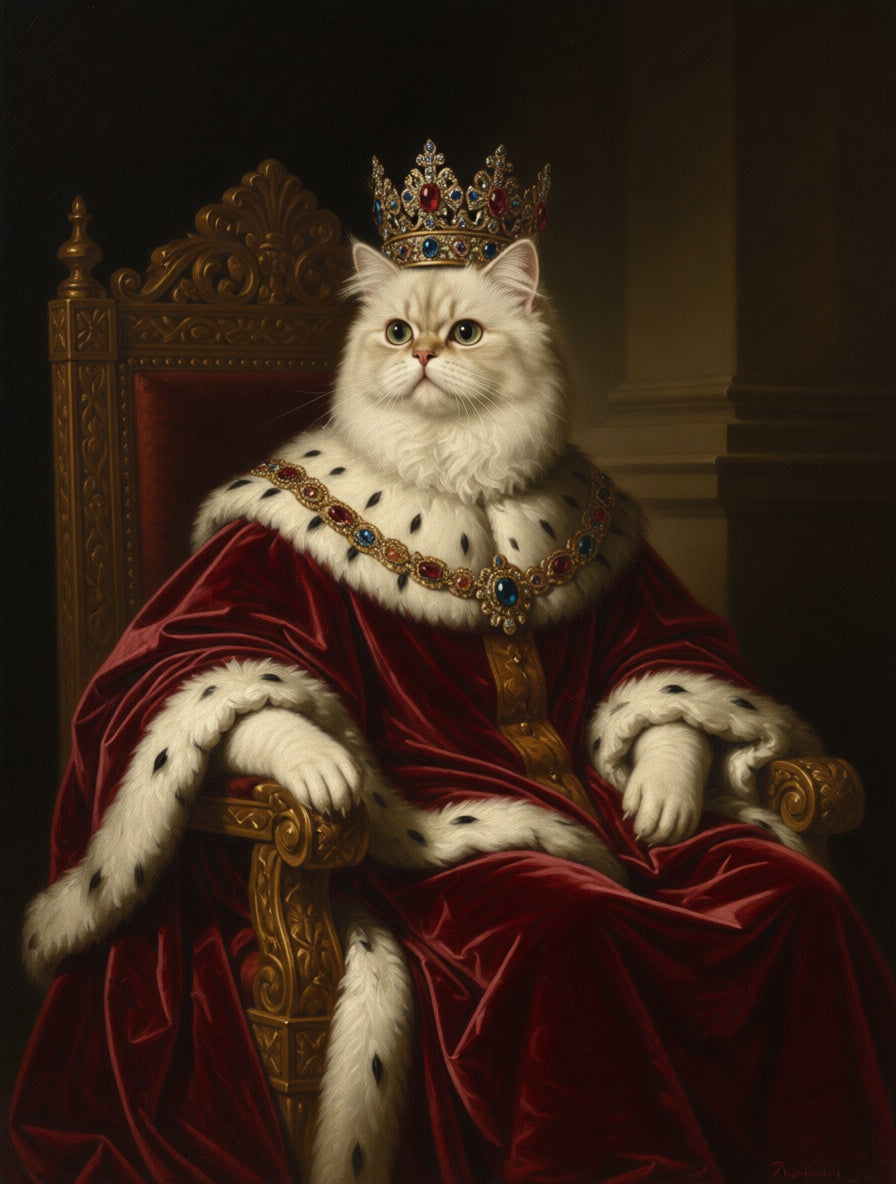
Look at any Victorian salon painting and you'll find a Persian at the lady's feet. The breed has been visual shorthand for nobility since long before AI got involved. Adding a crown and ermine-trimmed crimson robe doesn't transform a Persian — it makes explicit what the breed's bearing already implies. The result feels like a portrait that always existed and someone finally went and painted it.

Cobby shoulders, heavy robe

The Persian's compact, low-slung build is the right body for a heavy velvet robe. We cut the crimson to fall around the broad chest and short neck rather than hanging on a generic cat-shape; the ermine trim sits on the actual shoulder line. A king's robe should look weighty, and on a Persian's cobby frame it does — the painting reads as something the cat is wearing, not draped in.

Common questions

About this portrait

Will the crown sit naturally on a flat Persian head?
Yes — we is calibrated for brachycephalic shapes and fits the crown to the actual round Persian skull, with the jeweled rim above the ears and the base set into the dense ruff rather than balanced precariously. Doll-faced, peke-faced, and traditional Persians each get a crown cut to their specific head proportions; nothing looks pasted on.
Does my Persian's coat color and pattern survive the dark crimson palette?
Yes — your cat's exact coat (white, black, blue, red, cream, smoke, silver, tabby, calico, Himalayan point) is preserved precisely. The deep crimson robe is tuned to flatter your specific coat: warmer crimson around a black or smoke Persian, slightly cooler around a red or cream one, so the cat reads as the brightest, most legible point in the painting.
Are the large copper or blue eyes kept as the focal point of the portrait?
Completely. The Renaissance chiaroscuro is angled so the lit cheek and forehead frame the eyes, leaving them as the brightest, sharpest detail in the composition. Copper, blue, green, or odd-eyed Persians are all preserved exactly; the eyes are essentially the only thing we refuses to soften, no matter what else the painting does around them.

See your Persian in other styles

  • The Abstract

    From $19.99

    Preview →
  • The Admiral

    Preview →
  • The Art Nouveau

    Preview →
  • In the Autumn Forest

    Preview →